WHY YOU NEED TO PAY ATTENTION
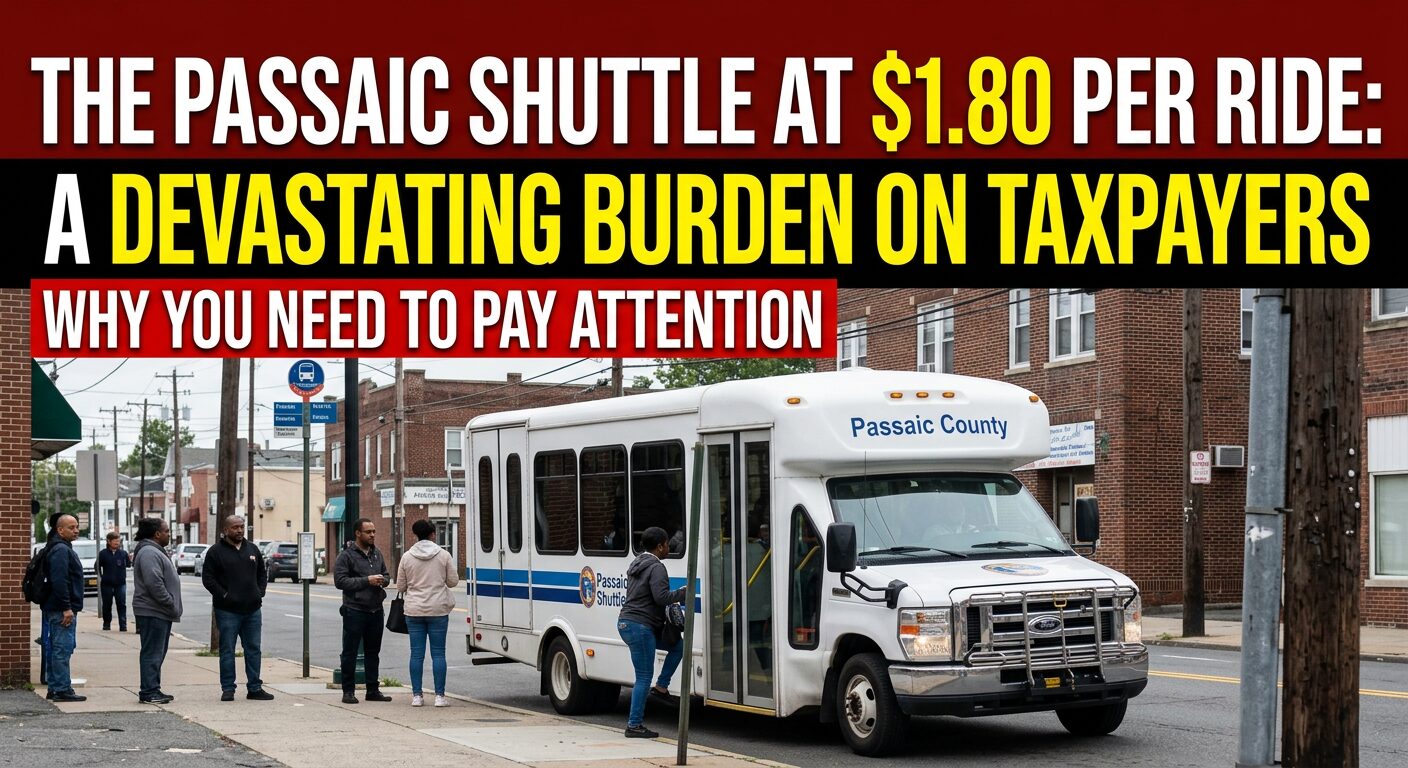
The Passaic Shuttle system represents one of the most glaring examples of fiscal mismanagement in New Jersey’s public transportation landscape. While riders pay just $1.80 per trip, the true cost to taxpayers tells a dramatically different story—one of massive subsidies, operational inefficiencies, and a system that has become an unsustainable drain on municipal resources.
The Real Cost Behind the $1.80 Fare
When passengers board the Passaic Shuttle and pay their $$1.80 fare, they’re covering only a fraction of what that ride actually costs. According to data from New Jersey Transit and municipal budget reports, the actual cost per passenger trip on many shuttle systems in New Jersey ranges from $$8 to $15 or more, meaning taxpayers are subsidizing anywhere from 80% to 90% of each ride.
The Passaic Shuttle operates as part of a broader network of local shuttle services that were designed to fill gaps in regional transit coverage. However, the economics of these systems have proven deeply problematic. The fare recovery ratio—the percentage of operating costs covered by passenger fares—for many New Jersey shuttle systems hovers around 10-20%, far below the industry standard of 30-40% for efficient transit operations.
Breaking Down the Financial Flaws
Massive Operating Deficits
The fundamental problem with the Passaic Shuttle is its inability to generate sufficient revenue to cover even basic operating expenses. Municipal transportation budgets reveal that shuttle services require millions in annual subsidies. For a city like Passaic, with a population of approximately 70,000 and a median household income below the state average, this represents an enormous burden.
The operating deficit must be covered through a combination of local property taxes, state subsidies, and federal grants. When state and federal funding falls short—as it frequently does—local taxpayers bear the brunt of the shortfall. This means homeowners and businesses in Passaic are effectively paying hundreds or even thousands of dollars annually in additional taxes to keep a shuttle system running that serves a relatively small percentage of the population.
Low Ridership and Poor Route Efficiency
One of the most significant flaws in the Passaic Shuttle system is chronically low ridership on many routes. Transportation studies have consistently shown that shuttle systems in smaller urban areas struggle to achieve the passenger density necessary for cost-effective operations. When buses run with only a handful of passengers—or sometimes completely empty—the per-passenger cost skyrockets.
According to transit planning principles, a bus route needs to maintain an average of at least 15-20 passengers per trip to approach cost-effectiveness. Many shuttle routes fall far short of this threshold, particularly during off-peak hours. This means taxpayers are funding buses that drive predetermined routes regardless of actual demand, burning fuel, requiring driver salaries, and incurring maintenance costs while serving minimal public benefit.
Duplicative Service and Poor Coordination
The Passaic Shuttle often operates in areas already served by NJ Transit bus routes, creating expensive duplication of services. This redundancy represents a massive waste of taxpayer resources. Rather than coordinating with existing regional transit to fill genuine gaps, shuttle systems frequently compete with or parallel existing routes, splitting an already limited ridership base and making both services less efficient.
Transit experts have long criticized the fragmented nature of New Jersey’s public transportation network, where multiple agencies and municipalities operate overlapping services without adequate coordination. The result is a system where taxpayers fund multiple buses traveling similar routes at similar times, each carrying fewer passengers than a single consolidated service would.
Inflated Labor Costs
Public sector transit operations typically carry significantly higher labor costs than private alternatives due to union contracts, pension obligations, and benefit packages. While fair compensation for transit workers is important, the cost structure of many municipal shuttle systems has become unsustainable.
Driver salaries, benefits, and pension contributions can account for 60-70% of shuttle operating costs. When combined with low ridership, this creates a situation where taxpayers are essentially paying $50-100 or more in labor costs alone for each passenger transported. Administrative overhead, including dispatchers, supervisors, and management staff, adds additional layers of expense that must be covered by taxpayer subsidies.
Vehicle Acquisition and Maintenance Costs
The capital costs of purchasing and maintaining shuttle buses represent another significant taxpayer burden. A single transit bus can cost $400,000 to $600,000 or more, and these vehicles require replacement every 10-15 years. For a shuttle system operating even a modest fleet of 10-15 buses, this represents millions in capital expenditures that must be financed through municipal bonds or grants—ultimately paid for by taxpayers.
Maintenance costs add substantially to the financial burden. Transit buses require specialized maintenance facilities, trained mechanics, and expensive parts. Annual maintenance costs per vehicle can easily exceed $20,000-30,000, and as buses age, these costs escalate dramatically. Taxpayers bear all of these expenses while riders pay only $1.80 per trip.
Insurance and Liability Costs
Municipal shuttle systems carry enormous insurance and liability costs that are rarely discussed in public debates about transit funding. The risk of accidents, injuries, and lawsuits requires comprehensive insurance coverage that can cost hundreds of thousands of dollars annually. When incidents do occur, settlements and legal costs can run into the millions, creating unexpected drains on municipal budgets that must be covered by taxpayers.
The Inequity of Taxpayer Subsidies
Perhaps the most troubling aspect of the Passaic Shuttle’s financial structure is the fundamental inequity it creates. The vast majority of Passaic residents never use the shuttle system, yet all property owners and taxpayers must subsidize it. This represents a massive wealth transfer from the general population to a small subset of regular riders.
Consider a typical homeowner in Passaic paying $8,000-12,000 annually in property taxes. A significant portion of that tax bill—potentially hundreds of dollars—goes toward subsidizing shuttle operations they never use. Meanwhile, a regular shuttle rider paying $1.80 per trip might take 200-300 trips annually, paying $360-540 in fares while consuming $2,400-4,500 in actual service costs. The difference—$2,000-4,000 per regular rider—comes directly from other taxpayers.
This subsidy structure is particularly problematic in economically struggling communities like Passaic, where many residents are already burdened by high property taxes relative to their incomes. Forcing these taxpayers to subsidize transportation for others, when they themselves may struggle to afford car ownership or other transportation needs, represents a deeply regressive policy.
Comparison to Private Alternatives
The inefficiency of the Passaic Shuttle becomes even more apparent when compared to private transportation alternatives. Ride-sharing services like Uber and Lyft typically charge $8-15 for trips within Passaic, which is comparable to or even less than the actual cost of shuttle trips. The key difference is that ride-sharing users pay the full cost themselves, while shuttle riders pay $1.80 and stick taxpayers with the rest of the bill.
Some municipalities have experimented with subsidized ride-sharing programs as alternatives to traditional shuttle services, with promising results. By providing vouchers or subsidies for ride-sharing services, cities can offer transportation assistance to those who need it while eliminating the massive fixed costs of operating a dedicated shuttle system. These programs typically cost 40-60% less than traditional shuttle operations while providing more flexible, convenient service.
The Political Economy of Transit Subsidies
The persistence of inefficient shuttle systems like Passaic’s can be largely explained by political economy factors. Transit systems create concentrated benefits for specific groups—riders, transit workers, unions, and bus manufacturers—while dispersing costs across the broader taxpayer base. This creates strong political incentives to maintain and expand services regardless of their economic efficiency.
Transit unions are particularly powerful political actors in New Jersey, consistently lobbying for increased funding and opposing reforms that might reduce costs. Politicians face significant pressure to maintain or expand transit services, as cutting routes or reducing service generates immediate, vocal opposition from affected riders, while the taxpayers bearing the costs remain largely unaware of how much they’re actually paying.
Environmental Claims Don’t Justify the Costs
Proponents of shuttle systems often justify massive taxpayer subsidies by claiming environmental benefits. However, these claims rarely withstand scrutiny when applied to low-ridership systems like the Passaic Shuttle. When buses run mostly empty, they actually generate more emissions per passenger-mile than private vehicles would.
A diesel bus getting 4-6 miles per gallon carrying only 3-5 passengers is far less environmentally efficient than those same passengers traveling in fuel-efficient cars or ride-sharing vehicles. The environmental case for transit subsidies only holds when buses achieve high ridership levels—something the Passaic Shuttle consistently fails to do.
The Opportunity Cost of Transit Subsidies
Every dollar spent subsidizing inefficient shuttle operations is a dollar that cannot be spent on other municipal priorities. Passaic faces numerous challenges—aging infrastructure, underfunded schools, public safety needs, and more. The millions spent annually propping up an inefficient shuttle system represent a massive opportunity cost.
Consider what else could be accomplished with the annual subsidy required to operate the Passaic Shuttle. Those funds could hire additional police officers, repair roads and sidewalks, upgrade school facilities, or reduce the property tax burden on struggling homeowners. Instead, they’re consumed by a transit system that serves a small fraction of residents while imposing costs on everyone.
Reform Options and Alternatives
Several reform options could address the fiscal problems of the Passaic Shuttle while still meeting legitimate transportation needs:
Means-Tested Subsidies: Rather than subsidizing all riders equally, the city could provide transportation vouchers to low-income residents, elderly individuals, and people with disabilities who genuinely need assistance. This would target subsidies to those who need them most while eliminating subsidies for riders who can afford to pay full cost.
Route Consolidation: Eliminating low-ridership routes and consolidating service on high-demand corridors could dramatically improve efficiency. Rather than running buses on fixed schedules regardless of demand, the system could focus resources where they’re actually needed.
Public-Private Partnerships: Contracting with private operators to provide shuttle services could reduce costs by 30-50% while maintaining service levels. Private operators typically achieve better efficiency through more flexible labor arrangements and better management practices.
Demand-Responsive Service: Replacing fixed-route shuttles with on-demand, app-based service could provide better coverage at lower cost. Passengers would request rides as needed, and vehicles would be dispatched accordingly, eliminating the waste of running empty buses on predetermined routes.
Fare Increases: While politically unpopular, increasing fares to cover a larger percentage of operating costs would improve the system’s financial sustainability and reduce the burden on taxpayers. Even doubling the fare to $3.60 would still leave it well below the actual cost, but would significantly improve the fare recovery ratio.
Conclusion
The Passaic Shuttle at $1.80 per ride represents a textbook case of well-intentioned public policy gone wrong. What was designed to provide affordable transportation has become an unsustainable drain on taxpayer resources, consuming millions in subsidies annually while serving a relatively small number of riders.
The system’s flaws are numerous and severe: massive operating deficits, chronically low ridership, duplicative service, inflated labor costs, and poor coordination with regional transit. These problems combine to create a situation where taxpayers subsidize 80-90% of every ride, effectively transferring wealth from the general population to a small subset of regular riders.
The inequity of this arrangement is particularly troubling in a community like Passaic, where many residents struggle with high property taxes and limited incomes. Forcing these taxpayers to subsidize transportation for others, while they receive no benefit themselves, represents a fundamentally unfair policy that demands reform.
While public transportation can play a valuable role in urban mobility, the current structure of the Passaic Shuttle is financially unsustainable and inequitable. Meaningful reform—whether through route consolidation, private partnerships, demand-responsive service, or targeted subsidies for those truly in need—is essential to protect taxpayers while still meeting legitimate transportation needs.
The longer political leaders delay addressing these problems, the more taxpayer money will be wasted on an inefficient system that benefits few while burdening many. The time for reform is long overdue.