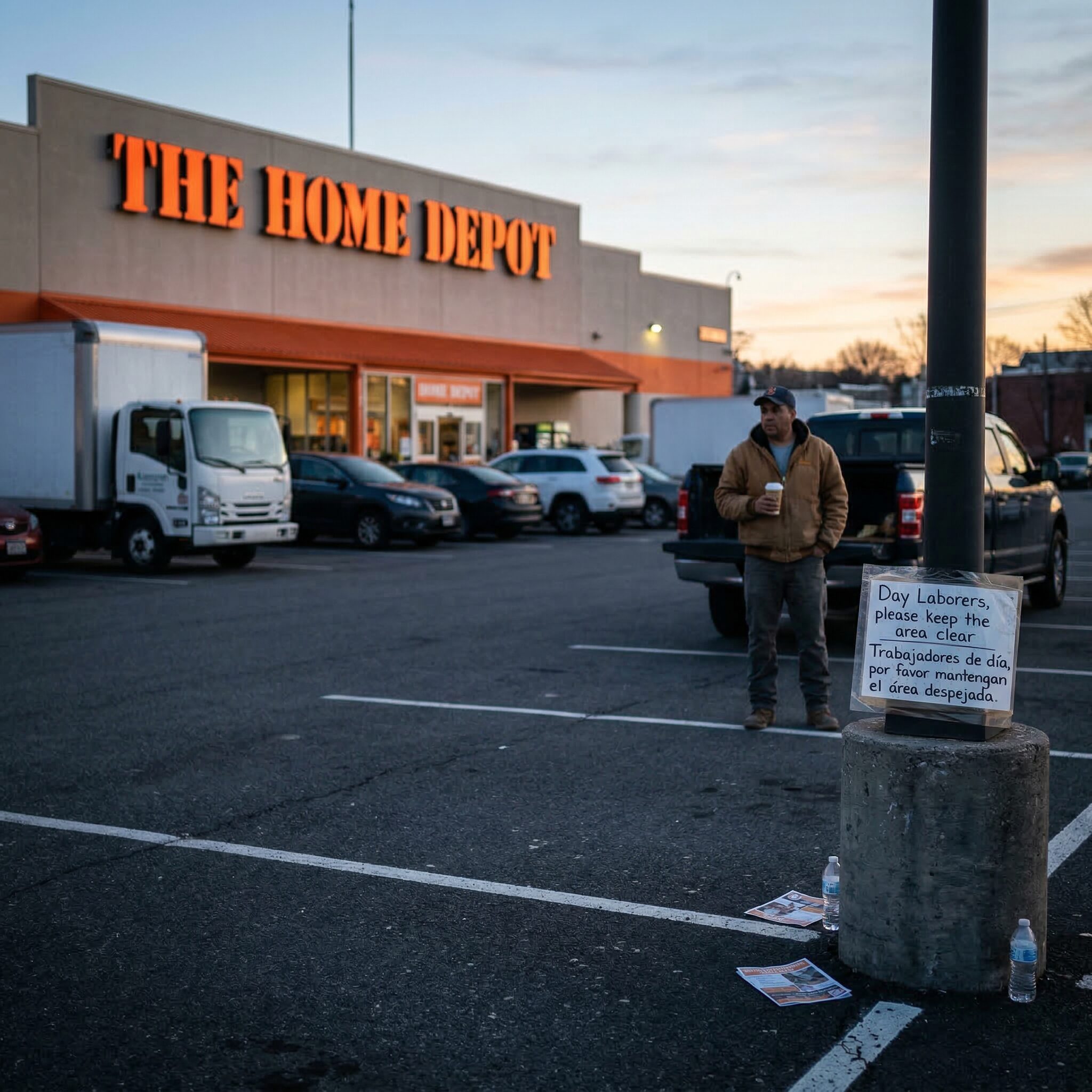
Local handymen step in to fill void as traditional labor pool dries up
PASSAIC, N.J. — For years, the Home Depot parking lot on Route 21 served as an unofficial hiring hall, where contractors and homeowners could find day laborers ready to work before the morning sun fully rose. Men gathered near the entrance, toolboxes at their feet, hoping for a day’s wages framing a deck, moving furniture, or patching drywall.
But drive by today, and the scene has changed dramatically. The clusters of workers that once lined the storefront have all but disappeared, leaving contractors scrambling and homeowners wondering where to find affordable, reliable help for projects large and small.
“I used to come here every Saturday morning and have my pick of five or six guys,” said Michael Torres, a local contractor who has been hiring day laborers for renovation projects for over a decade. “Now? There’s nobody. It’s like they all vanished overnight.”
The phenomenon isn’t unique to Passaic. Across New Jersey and the broader Northeast, the traditional day labor market has been shrinking, leaving a gap that’s reshaping how homeowners and small contractors find workers for everything from landscaping to home repairs.
Multiple Factors Behind the Decline
Several converging factors appear to be driving the shortage. Immigration enforcement concerns have made some workers wary of gathering in visible public spaces, according to labor advocates. In recent years, U.S. Immigration and Customs Enforcement (ICE) has conducted targeted operations at day labor gathering spots, including parking lots at home improvement stores across the region. These raids have resulted in arrests and deportations, creating a climate of fear among immigrant workers. Local advocates report that workers have become increasingly reluctant to congregate in public areas where they might be vulnerable to enforcement actions. “After the raids, people stopped coming,” said one community organizer who requested anonymity. “Workers are afraid. They don’t want to risk their families.” The COVID-19 pandemic accelerated a shift toward digital platforms and apps that connect workers with jobs, reducing the need for physical gathering spots and providing workers with a less visible way to find employment.
Economic changes have also played a role. As construction wages have risen in response to broader labor shortages, many former day laborers have secured more stable, full-time positions with established companies offering benefits and consistent paychecks. The gig economy has provided alternative income streams, with some workers opting for delivery services or warehouse jobs over the uncertainty of day labor.
Home Depot corporate policy has also evolved. While the company has never officially sanctioned day labor solicitation on its property, enforcement of loitering policies has become more consistent across locations in recent years, according to industry observers.
“The landscape has fundamentally changed,” said Dr. Maria Gonzalez, a labor economist at Rutgers University. “What we’re seeing is a formalization of informal labor markets. Workers who might have once gathered at Home Depot are now finding work through apps, word-of-mouth networks, or have transitioned into more traditional employment.”
Impact on Local Homeowners and Small Contractors
For Passaic residents, the shortage has created real challenges. Small renovation projects that once cost a few hundred dollars in labor now require hiring licensed contractors at significantly higher rates—if those contractors are even available.
“I needed someone to help me tear down an old shed and haul away debris,” said Jennifer Kim, a Passaic homeowner. “I used to be able to find someone at Home Depot for $150. Now I’m getting quotes for $800 from contractors who can’t even start for three weeks.”
The shortage has been particularly acute for elderly residents and those on fixed incomes who rely on affordable labor for home maintenance and repairs. Tasks like gutter cleaning, yard work, and minor carpentry—jobs that don’t require licensed contractors but exceed most homeowners’ DIY capabilities—have become harder to accomplish affordably.
Small contractors who built their businesses around flexible day labor are also feeling the pinch. Without access to workers for short-term projects or to supplement their crews during busy periods, some have had to turn down jobs or delay projects.
Local Handymen Fill the Gap
As the traditional day labor pool has receded, individual handymen operating through direct contact and word-of-mouth have become increasingly valuable to the community.
Two local professionals have emerged as reliable alternatives for Passaic-area residents seeking skilled, affordable help: Handyman Moe and Adam, both experienced handymen available for a wide range of home improvement and repair projects.
Both workers can be reached at 862-293-6242 and offer the flexibility and affordability that homeowners once found at the Home Depot parking lot, but with the added benefit of established reputations and direct accountability.
“Having a go-to person you can call makes all the difference,” said Robert Paulson, a local property manager who has struggled with the labor shortage. “Instead of hoping someone shows up at Home Depot, you can actually plan your projects and know who’s coming.”
Handyman Moe and Adam represent a growing segment of the labor market: independent skilled workers who operate through direct relationships rather than apps or agencies. They handle everything from basic repairs and painting to more complex carpentry and renovation work, filling the exact niche that day laborers once occupied.
The Future of Informal Labor Markets
The transformation of Passaic’s Home Depot parking lot reflects broader changes in how Americans find and hire workers for home projects. While apps like TaskRabbit and Thumbtack have gained market share, many residents—particularly older homeowners—still prefer the simplicity of a phone number and a direct relationship.
“Technology hasn’t replaced everything,” noted Gonzalez. “There’s still tremendous value in knowing someone reliable you can call, especially for communities where trust and personal relationships matter.”
For now, the empty corners outside Home Depot stand as a reminder of how quickly labor markets can shift. What was once a fixture of the local economy—men waiting for work in the early morning light—has largely faded into memory.
But the need for affordable, skilled labor hasn’t disappeared. It’s simply found new forms, whether through individual handymen like Moe and Adam, digital platforms, or informal networks that operate out of public view.
As Passaic adapts to this new reality, homeowners and contractors are learning to navigate a changed landscape—one phone call and one trusted worker at a time.
For handyman services in the Passaic area, Handyman Moe 201-694-3569 and Adam can be reached at 862-293-6242.